Last updated November 18, 2026


Free written scope consultation - allowances, timeline, and change-order rules on paper before a single trade is scheduled
Driveway & Pavers Troubleshooting: Common Problems and How to Fix Them
If your pavers sank in one specific zone and nowhere else, the problem almost certainly isn’t the pavers. It’s a buried irrigation line or a drainage pipe that’s been leaking slowly enough that nobody noticed until the surface told on it. We’ve pulled up plenty of Doral driveways where the homeowner spent two weekends re-sanding a low spot that kept coming back, and the actual cause was a hairline break in a sprinkler lateral three inches under the bedding layer. This guide maps each visible symptom to its real mechanical origin, so a repair fixes the cause rather than dressing the symptom. You’ll learn the five failure patterns, how to tell three kinds of staining apart, and how to reset a sunken section yourself.
Quick Answer
Most paver problems trace back to water or base failure, not the pavers themselves: sinking and shifting mean the sub-base settled, washed out, or was never compacted properly, while staining and white haze are surface chemistry. A single rocking unit is usually a bedding problem you can fix in an afternoon. A whole zone that sags or a corner that lifts points to drainage or base failure that needs excavation, not a sand top-up. Diagnose the pattern first, then choose the repair.
Styles & brands we work with
- Kitchen remodeling
- Bathroom remodeling
- Home additions & ADU
- Roofing
- Windows & doors
- Driveway & pavers
- Fence
Table of Contents
- The Five Failure Patterns and What Each One Tells You
- Why Do Pavers Sink and Shift?
- Efflorescence vs. Mold vs. Oil Staining: Telling Them Apart
- How to Reset a Sunken Section Yourself
- When a Repair Is Really a Failed Base
- What Documentation a Contractor Should Hand You After a Reset
- Common Mistakes to Avoid
- When to Call a Professional
The Five Failure Patterns and What Each One Tells You
The shape of a failure is diagnostic. Before you touch anything, stand back and look at where the movement is concentrated. Five patterns show up over and over, and each one points to a different layer of the system.
- Corner lift. One corner of a unit rides up above its neighbors. Usually a tree root pushing from below or a paver set on a high spot of bedding sand. It can also be the first sign of frost-style heave, though in Doral’s climate the culprit is nearly always roots or debris left in the bedding.
- Center sag. A broad dip in the middle of the drive or walkway. This is sub-base settlement or a washout beneath the base layer. Water is getting under the pavers and carrying fines away.
- Single-unit rocking. One paver teeters when you step on it. The bedding sand under that unit has thinned or shifted. This is the easiest repair and often an afternoon job.
- Edge migration. The outer row creeps outward and the joints open up. The edge restraint has failed or was never installed deep enough. Without restraint, pavers walk.
- Surface scaling. The top face flakes or pits. This is a manufacturing or freeze-thaw issue, not a base problem, and it usually means the wrong paver type was specified for the exposure.
Match the pattern to the layer and you’ve diagnosed the job. A rocking unit lives in the bedding. A center sag lives in the base. Edge migration lives at the perimeter. Writing down which pattern you have keeps you from buying three bags of polymeric sand when the real fix is a new edge restraint.
Why Do Pavers Sink and Shift?
Pavers sink and shift for one reason: the layer beneath them stopped doing its job. A properly built paver system is four layers, and each has to hold. The soil subgrade must be stable and compacted. The aggregate base, usually crushed stone, carries the load and drains water. The bedding sand levels the pavers and locks the joints. And the pavers themselves take the wear. When any of the first three fails, the surface moves.
In Doral, the specific causes tend to be local. The water table sits high and heavy summer rain arrives fast, so drainage matters more here than in drier markets. When water can’t escape, the base stays saturated, and saturated base loses strength. That’s when you get the broad center sag. We also see a lot of buried irrigation laterals under driveways in established Doral neighborhoods. A slow leak softens the base under one zone, the pavers settle into the void, and the owner assumes the pavers “went bad.” They didn’t. The pipe did.
Other common causes:
- Improper compaction at install. Base stone that was dumped and walked on instead of plate-compacted in lifts will settle under load over time.
- Insufficient base depth. A driveway carrying vehicles needs a thicker base than a footpath. Skimping shows up within a season or two under car tires.
- Missing or shallow edge restraint. Without a properly set edge, the whole field creeps. This is the source of most edge migration and the open joints that follow.
- Poor surface drainage. Water pooling against the pavers instead of running off means the base is absorbing what it should be shedding.
If you want the full picture of how a correct installation is built, our Driveway & Pavers in Doral page walks through the layers from subgrade up. The point here is narrow: find which layer failed before you fix the surface.
Efflorescence vs. Mold vs. Oil Staining: Telling Them Apart
Three stains look similar in a photo and need completely different treatment. Using the wrong cleaner doesn’t just fail to remove the stain. It can etch or damage the paver face permanently, and you can’t buff that out. Here’s how to tell them apart before you buy a jug of anything.
Efflorescence is a white, powdery haze that sits on the surface and brushes away easily at first. It’s mineral salt migrating up through the concrete as moisture evaporates. It’s cosmetic and common on new pavers. It is not mold and it is not dirt.
Mold and mildew look green-grey to black and tend to concentrate in shaded areas, along north-facing edges, and in joints that stay damp. In Doral’s humidity, shaded walkways grow it fast. It feels slightly slick and smears when you rub it.
Oil and rust staining are dark, localized, and follow the drip pattern of whatever leaked. Driveway pavers in Doral pick these up from parked cars, irrigation heads that spray rusty water, and fertilizer. They don’t brush away and they don’t smear like mold.
Matching the cleaning chemical to the stain:
- Efflorescence: a mild acid-based paver cleaner, diluted per the label, then rinse. Dry-brushing first helps. Repeat after the pavers fully dry, since salts can resurface once.
- Mold and mildew: an oxygen-based cleaner or a diluted bleach solution, scrubbed and rinsed. Never a strong acid here, which can etch the face and strip the color.
- Oil: a dedicated oil-stain remover or a poultice that draws the oil out. Solvent-based degreasers can drive the stain deeper if you over-wet it.
- Rust: an oxalic-acid rust remover, applied sparingly and rinsed thoroughly.
Test any cleaner on a spare paver or an inconspicuous corner first. One wrong acid application on a colored paver leaves a bleached patch that no amount of re-sanding hides.
How to Reset a Sunken Section Yourself
A single sunken unit or a small area bounded by intact neighbors is a reasonable DIY repair, provided the base underneath is sound. This is the one part of paver work homeowners can do safely and well. If the whole zone sags, skip to the base-failure section instead; resetting pavers over a failed base just resets the problem.
Tools you’ll need: two paver pullers or a stiff putty knife and a small pry bar, a rubber mallet, a hand tamper, a level, a bucket, a broom, and polymeric sand. A paver puller runs about $20 to $40 for a pair. Polymeric sand runs roughly $25 to $40 per bag depending on brand, and you’ll need one to two bags for a single small repair.
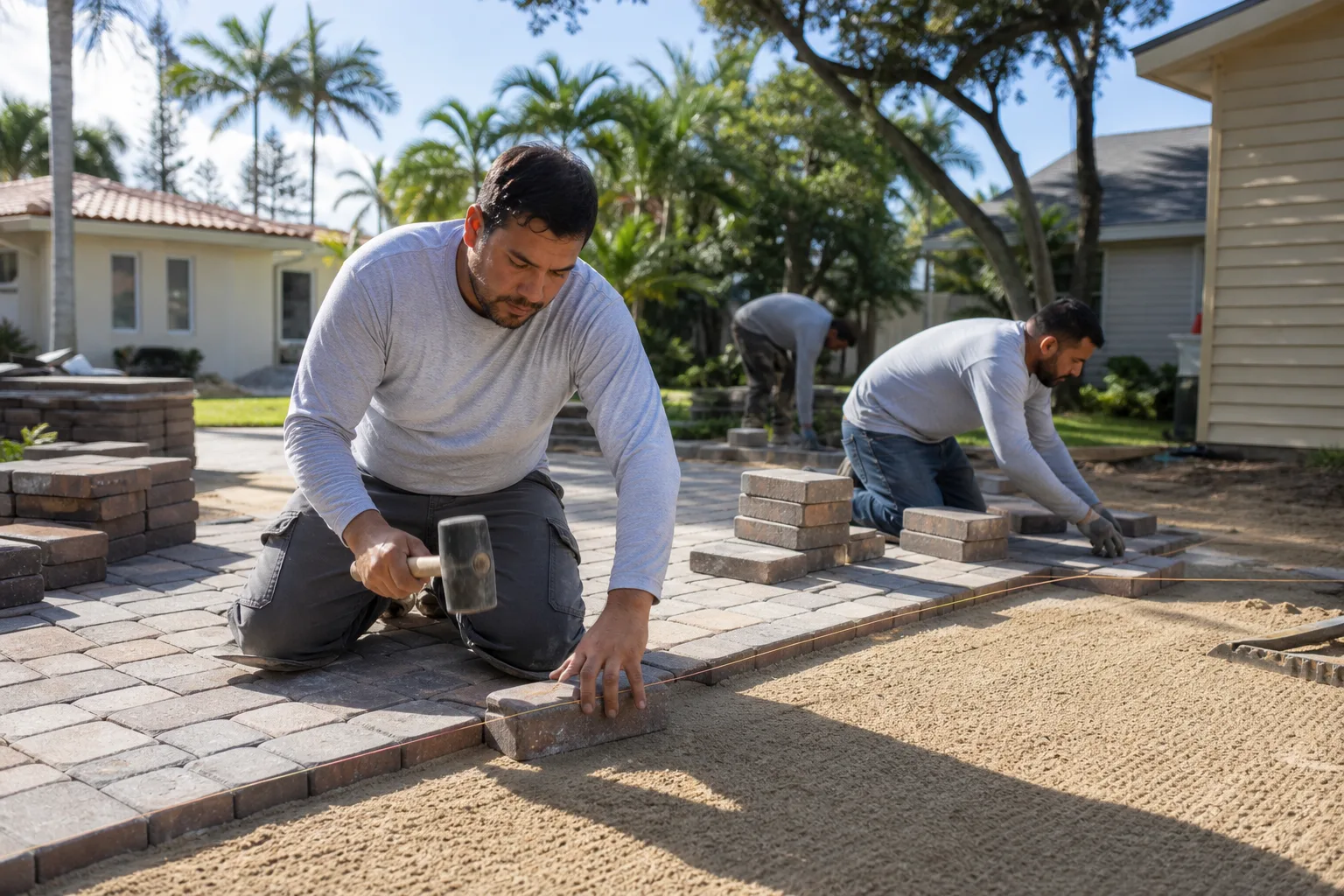
- Lift the sunken unit. Work a paver puller into the joint on two sides and lift straight up. Set the paver aside.
- Expose the cause. Look at what’s under it. Loose, wet bedding sand means water is getting in. A void or a soft spot means the base has settled. A broken pipe or root means stop here and fix that first.
- Re-level the bedding. Add or remove a thin layer of bedding sand until it’s even with the neighbors. Keep it to about an inch; more than that and it will settle again.
- Compact lightly. Tamp the bedding with a hand tamper so it holds before you set the paver.
- Re-set the paver. Drop it in and tap it flush with the rubber mallet. Check it against a level and against the surrounding units.
- Re-sand the joints. Sweep polymeric sand into the joints, compact it, top it off, then mist it with water per the label to activate the binder. Let it cure before traffic.
Keep the removed paver somewhere out of the way while you work; the goal is to put the same one back, not a new one, so the color and size stay matched. When a small Doral repair is done right, the surface and the fix both last. When it’s done over a soft base, it fails again within a season.
When a Repair Is Really a Failed Base
This is the decision point most homeowners get wrong. They see a dip, buy sand, and chase the problem for two years. There’s a threshold, and you can check it yourself before calling anyone.
A surface repair is enough when:
- The movement is confined to one or two units.
- The surrounding pavers are flat and tight.
- The lifting unit rocks but doesn’t sink into a void.
- The joints around it are intact.
A surface repair is a bandage when:
- An area larger than about a square foot is sagging or the dip is spreading.
- Water pools on the pavers or against the edges after rain.
- The edge row is creeping and joints are opening along a run.
- You find a soft, spongy spot or standing water under a lifted paver.
- The same spot has sunk twice after a reset.
Any of those second-list indicators means the base needs excavation, re-grading, re-compaction, and possibly new drainage before new bedding and pavers go back down. A broken irrigation line under the drive needs fixing before anything is set over it, or you’ll be back at the same spot next summer. This is where a contractor’s diagnosis earns its keep, because the visible symptom and the hidden cause are in different layers.
What Documentation a Contractor Should Hand You After a Reset
After a proper re-set, the repair should come with evidence, not just a clean surface. You can’t see under the pavers once the crew leaves, so ask for the record. At a minimum:
- Photos of the exposed base before anything was re-covered, showing what was found and what was corrected.
- Compaction results for the base after re-compaction, so you know the layer underneath is actually holding.
- A written warranty on the sub-base work separate from any warranty on the surface or the sand.
- A written scope and price before work starts, with any change documented on a signed change order.
That’s the standard we hold ourselves to under the Haven Standard, and our Home Additions & ADU in Doral work carries the same documentation on a much bigger scale. The photo record is included on every visit, not an add-on. When a contractor hands you photos of the base, compaction readings, and a warranty page, you can evaluate the work after the fact instead of trusting a promise.
Common Mistakes to Avoid
- Filling a dip with sand and calling it fixed. Sand in the joints is not base repair. A broad sag means water is under the pavers, and topping it off just hides the void for a season.
- Power-washing joints into holes. A pressure washer on full blast blasts out the bedding sand and the joint sand both, which destabilizes every unit nearby. In Doral’s humidity it also pushes moisture into the base.
- Using the wrong cleaner on a stain. Strong acid on mold etches the paver face and strips color. Bleach on efflorescence does little. Match the chemical to the stain before you spray.
- Resetting pavers over a leaking irrigation line. The single most common repeat failure we diagnose. Fix the buried cause first, then the surface.
- Skipping the edge restraint. Without a properly set edge, the field creeps and joints open. New sand won’t hold a migrating edge.
- Ignoring drainage on a slope. In Doral’s storm season, water that runs across pavers instead of off them finds the weakest joint every time.
- Selecting a porous paver for a wet, shaded spot. Surface scaling and staining follow. Match the material to the exposure, not just the color you like.
See the difference
 Before
 After
 Before
 After
 Before
 After
When to Call a Professional
Call a professional when the pattern points below the surface: a whole zone that sags, an edge that won’t stay put, standing water after rain, or a repair that has failed twice in the same spot. Those are base and drainage jobs that need excavation, compaction equipment, and a diagnosis of what’s under the pavers. Call sooner rather than later, since a base problem gets more expensive once water has undermined a larger area. Call also if the drive meets a structure, a retaining wall, or a slope that drains toward the house, where the fix has to tie into grading. Rowan Construction Group Doral offers free estimates in Doral, with a written price and scope before any work begins; call (888) 300-3896 and we’ll diagnose the pattern and map it to the layer that failed.
Frequently Asked Questions
A localized sink almost always means a leak or void under that one area, usually a buried irrigation line, a drainage pipe, or a pocket where water collects and washes the base out. The rest of the drive stays flat because that area’s base is still sound. Diagnose what’s under the sunken unit before you re-sand.
Yes, a single rocking unit is a reasonable DIY repair if the base beneath it is solid. Lift it, re-level the bedding sand, compact, re-set the paver, and re-sand the joint. If you find a soft spot or wet sand underneath, stop and get the base checked instead.
Efflorescence is white and powdery and brushes away; it’s mineral salt rising to the surface as moisture evaporates. Mold is green-grey to black, feels slick, smears when rubbed, and shows up in shaded, damp areas. They need different cleaners, so identify the stain first.
A single-unit reset with re-sanding is a small job; a base excavation and rebuild on a larger area costs more because it involves removing pavers, correcting the base, and re-compacting. The number depends on area and what’s under the pavers, which is why a written scope matters. Call (888) 300-3896 for an exact quote; estimates are free.
Spreading edges mean the perimeter restraint has failed or was never set deep enough. Without a solid edge, the field creeps outward and joints open. Re-sanding the joints won’t fix it; the edge restraint has to be corrected.
A little tight settling over time is normal, but sinking after rain usually signals water getting into an underdrained base. Doral’s high water table and fast summer storms put real load on drainage. If a spot pools or sinks after storms, the fix is drainage and base, not sand.
The Bottom Line
Every paver problem has a visible symptom and a hidden cause, and treating the symptom over a sound base is fine only when the base is actually sound. Match the failure pattern to the layer: a rocking unit and a spreading edge are surface jobs, while a center sag and a repeat sink are base and drainage jobs. Identify the stain before you choose a cleaner. When the pattern points below the surface, get a written diagnosis and a documented photo record of the exposed base. If you’d like help mapping it, our crews have up to 19 years of experience and carry the same documented approach across our Fence Installation in Doral and every other trade.
Call Rowan Construction Group Doral at (888) 300-3896 for a free estimate. We’ll send out background-checked, uniformed technicians, and a live person answers calls 24/7. You’ll get a written price and scope before any work starts, a documented photo record of what we found and did, and the 365-Day Done Right Promise behind the job. If you have a written estimate from another contractor, bring it and we’ll review it line by line at no charge. See what we do across all seven trades on the Rowan Construction Group Doral home page.
Written by the team at Rowan Construction Group Doral.