Last updated November 18, 2026







Free written scope consultation - allowances, timeline, and change-order rules on paper before a single trade is scheduled
Windows & Doors Troubleshooting: Common Problems and How to Fix Them
A window that leaks when it rains hard and a window that leaks when the AC runs are two completely different failures, with two different repair bills. One is bulk water pushing past failed flashing. The other is warm humid air condensing on cold glass. Homeowners call both “my window leaks,” and if the contractor starts the conversation without establishing which one they’re describing, the first visit is wasted. This guide sorts South Florida window and door problems by symptom rather than by brand, so when you talk to a contractor in Doral or anywhere across Miami-Dade, you can say exactly what you’re seeing. We’ll cover what each symptom points to, how to tell a failed window unit from a failed installation, and when a repair crosses the line into replacement.
Quick Answer
Most window and door problems in South Florida trace to two root causes: aluminum frame oxidation in salt air, and improper flashing that lets bulk water get behind stucco. Diagnose by symptom first – water on the sill during rain points to flashing or sealant failure, moisture inside the glass means the insulated unit’s seal is gone, and condensation on the frame rather than the glass means air infiltration. Each points to a different fix and a different cost.
Styles & brands we work with
- Kitchen remodeling
- Bathroom remodeling
- Home additions & ADU
- Roofing
- Windows & doors
- Driveway & pavers
- Fence
Table of Contents
- The Symptom-to-Cause Matrix: Four Problems, Four Fixes
- Failed Window Unit vs. Failed Installation: Which Warranty Applies
- Sliding Glass Doors: Rollers, Tracks, and the Repair-or-Replace Line
- Stucco Cracking Around Windows: Cosmetic or Active Leak?
- The Hose Test, Step by Step
- When a Fix Needs a Permit in Miami-Dade
- Common Mistakes to Avoid
- Frequently Asked Questions
The Symptom-to-Cause Matrix: Four Problems, Four Fixes
Window and door failures show up as a small number of repeat symptoms, and each one narrows the cause fast. When we run a diagnostic visit, the first question is always when the problem appears, not what brand is on the frame. Here is how the symptoms sort out, and what each repair typically runs in the Doral market.
- Water on the sill during rain – flashing or sealant failure where water gets behind the frame or under the stucco. Repairs usually run $350 to $1,200 per opening depending on how much stucco has to come off to reach the flashing.
- Condensation between the panes – the factory seal on an insulated glass unit (IGU) has failed. Foggy glass cannot be repaired; the sealed unit is replaced, typically $250 to $650 per unit installed for standard sizes.
- Condensation on the frame or interior glass in humid weather – air infiltration or a thermal break problem, not a glass failure. Weatherstripping, glazing, and frame resealing usually fall in the $150 to $400 range.
- Hardware that won’t latch or a door that drags – frame racking (the opening has shifted out of square) or worn hardware. Hardware replacement is inexpensive; racking points to a structural or settlement issue that costs more to correct.
Why does Doral see so much of the first category? Salt-laden air off Biscayne Bay oxidizes aluminum frames faster than inland conditions do, and the summer rain pattern delivers hard, wind-driven bursts that find every gap in sealant. A bead of caulk that would last years in a drier climate can fail in a couple of seasons here. That’s the reality behind most “it only leaks in heavy rain” calls we take.
Failed Window Unit vs. Failed Installation: Which Warranty Applies
This distinction decides who pays. A failed window unit – fogged glass, a broken sash, a hinge that snapped – is a product defect, and the window manufacturer’s warranty may cover the part. A failed rough opening – water getting behind the frame because the flashing was done wrong or never done – is an installation problem, and the manufacturer will point to the installer. Knowing which one you have before you call saves weeks of being bounced between the two.
Here’s how to separate them:
- Look at where the water enters. Water between the panes is inside the sealed unit. Water on the interior sill or running down the wall is coming from outside the frame, which means installation.
- Check the frame for staining or bubbling. Rust streaks, paint bubbling, or soft spots on the frame suggest water is sitting against it, a flashing or sealant problem, not a product failure.
- Note whether the leak is at the head, sides, or sill. Leaks at the head (top) usually mean failed flashing above the window. Sill leaks point to the pan flashing or weep system.
- Test with a hose (details below) to confirm water entry from outside before you file any warranty claim.
In our experience, most “warranty” calls on South Florida windows turn out to be installation issues once the flashing is exposed. That’s not a knock on any brand – it’s the difference between what leaves the factory and what happens on the wall. When you’re ready to have that diagnosed properly, it helps to have a contractor who can read the flashing, not just replace the glass. For homes in the area considering new openings entirely, see our work on Home Additions & ADU in Doral, where window and door detailing is planned from the framing stage.
Sliding Glass Doors: Rollers, Tracks, and the Repair-or-Replace Line
Sliding glass doors are the most common door repair we see in Doral, and the failure pattern is predictable. The rollers wear out first, the track corrodes from salt air next, and at some point the cost of chasing repairs passes the cost of a replacement door. Here’s the rough timeline and where the money lands.
- Rollers – typically last 8 to 12 years in a covered opening, less where sun and humidity are constant. Replacing a pair of rollers runs about $120 to $350 depending on the door and access.
- Tracks – aluminum tracks pit and oxidize in salt air, causing the door to stick and jump. Cleaning and resurfacing helps temporarily; replacing a corroded track section runs $200 to $500.
- Seals and weatherstripping – the weak point for air and water. Replacing the sweep and weatherstripping is usually $80 to $200 and stops the “it whistles and sweats” complaint.
The repair-or-replace line is usually about $700 to $900 in cumulative repairs. Past that point, a new impact-rated sliding door – required in much of Miami-Dade for replacement openings – makes more financial sense, typically $2,500 to $5,500 installed depending on size and product. If the door is also failing structurally – sagging, hard to lock, water coming under the track during rain – it’s usually replacement time regardless of the number. We’ve watched Doral homeowners sink four figures into a door that still leaked, because the tracks were being patched when the rough opening behind them was the real problem. If the door frames a space tied to a larger project, our page on Driveway & Pavers in Doral covers how exterior transitions should be detailed so water sheds away from the door threshold.
Stucco Cracking Around Windows: Cosmetic or Active Leak?
Every stucco home in South Florida gets hairline cracks around window and door openings. Most are shrinkage cracks from curing and seasonal movement, harmless. Some are active water paths that let rain into the wall cavity, and those are the expensive ones. The difference isn’t always visible to the eye, which is why we test rather than guess.
How to tell them apart:
- Hairline cracks (paper-thin, less than 1/16 inch) that haven’t grown across seasons are usually cosmetic.
- Wider or growing cracks, cracks that follow a pattern, or cracks with staining, efflorescence (white mineral deposits), or soft stucco around them suggest water is getting in.
- Cracks that start at the window corners and run diagonally often follow the framing and the corner of the opening, a common place for movement and water entry.
- Interior bubbling, staining, or peeling paint on the inside wall below or beside the window means water has already crossed the wall cavity.
When we see cracking around a window in Doral, the first thing we do is look at the stucco reveal and the sealant joint at the frame, because the joint between window frame and stucco is where most infiltration starts. If the joint was sealed with a cheap caulk or the flashing was run wrong, the crack is a symptom. Under the Haven Standard’s documentation practice, our technicians photograph each opening and mark the cracks before any patching, so the record shows what was there.
The Hose Test, Step by Step
When a window leaks “sometimes,” a hose test is the cheapest way to find out if it’s a real infiltration problem and where. It’s not a substitute for a contractor’s inspection, but it gives you facts to describe on the phone. Here’s how we run one:
- Pick a dry day and a window where you’ve seen the problem. Have a second person inside with a flashlight and a towel.
- Start at the bottom (sill) and work up. Play a gentle stream – not a pressure blast – against the sill and low corners for two to three minutes. Watch for water inside.
- Move to the sides and frame joints. Test each corner and the sealant joint between frame and stucco for a minute or two.
- Test the head last. Run water above the window at the flashing zone for three to five minutes, checking for water at the head and along the top of the frame.
- Note the time and location where water first appears inside. That’s your evidence, and it’s exactly what a contractor needs to hear.
Don’t test from a ladder at height or on a steep roof – that’s work for trained professionals with the right equipment. If you can’t reach the head safely, test the sill and sides only and note it. A hose test that shows nothing after ten minutes of gentle water may still be a real problem under wind-driven rain, so absence of water is not proof of a good seal. For homes with hardscape and drainage nearby, our article on Driveway & Pavers in Doral explains how surface water should be graded away from openings, because a leaking window can sometimes be a grading problem.
When a Fix Needs a Permit in Miami-Dade
Not every window fix requires a permit, and knowing the line saves you time and money. In Miami-Dade, like-for-like maintenance – replacing a piece of weatherstripping, a roller, a pane of glass in the same frame, recaulking a sealant joint – generally doesn’t require a permit because it restores the original condition without changing the opening or the product type. What does require a permit is anything that changes the window or door itself: replacing a unit with a different size or product, replacing an entire window or door assembly, or installing impact glazing.
- No permit (typically): weatherstripping, rollers, sweeps, a single glass pane in the same frame, sealant and caulk renewal, hardware like latches and handles.
- Permit typically required: full window or door replacement, changing a product to impact-rated glass, enlarging or altering an opening, work affecting the structural frame or flashing system.
Miami-Dade is strict about impact protection in the wind-borne debris region, so full replacements get plan review and inspection. We pull permits and pass inspections as part of the work, because a permit is documentation – exactly the kind of written record that matters when you sell or insure the home. In Doral specifically, replacement windows and doors in many subdivisions also need approval from the homeowners association before the building department, so plan the paperwork before the crew shows up. For a broader sense of the exterior work tied to these openings, our Fence Installation in Doral page covers matching new perimeter construction to the right impact standards.
Common Mistakes to Avoid
- Caulking the symptom instead of diagnosing the cause. A fresh bead of sealant over a failed flashing will hold for a season, then fail again – and by then the rot has started. Test before you seal.
- Assuming a warranty will cover the leak. Manufacturer warranties cover the product, not the installation. Pull out the paperwork and find out what’s in writing before you call.
- Confusing glass condensation with frame condensation. Fog between the panes is a new sealed unit; moisture on the frame is a sealant or weatherstripping job. They are different prices and different trades.
- Replacing hardware on a racked frame. If the door or window won’t latch because the opening is out of square, new hardware won’t fix it. The frame needs to be checked first.
- Patting down rotten wood and calling it sealed. In Doral humidity, soft wood and bubbling paint around an opening spread quickly. Probing with a screwdriver tells you in seconds whether the frame substrate is sound.
- Skipping the documentation. Photograph the before and after on every repair. When you sell the house or file a claim, that photo record is the proof.
- Ignoring the stucco joint until it leaks hard. The sealant joint between frame and stucco fails silently. An annual look in the dry season catches it before the rainy one.
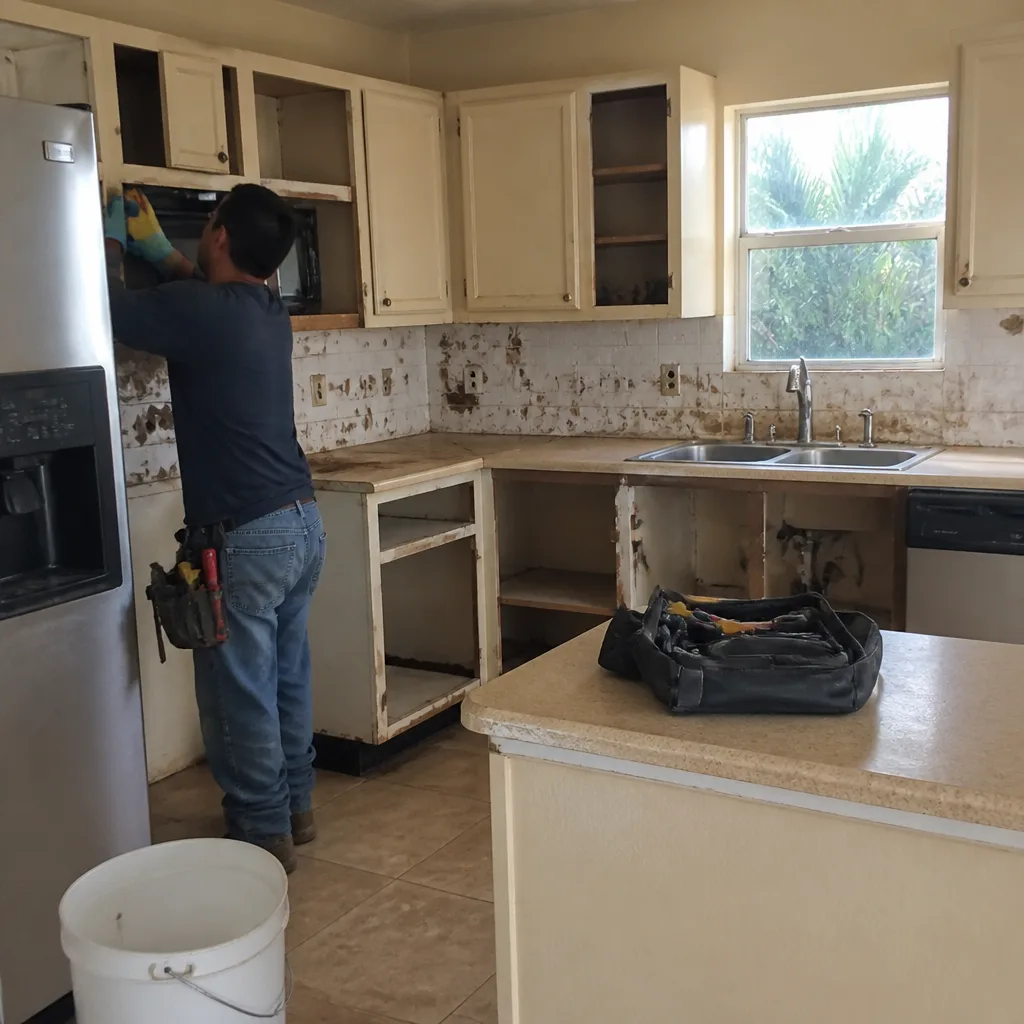
See the difference
 Before
 After
 Before
 After
 Before
 After
When to Call a Professional

Some of these fixes are within reach for a careful homeowner: replacing weatherstripping, resealing a joint, cleaning a track. Call a professional when water is reaching the wall cavity, when you can’t safely get to the flashing or the head of the opening, when a door or window sags or won’t lock, or when the diagnosis itself is unclear. Window and door openings sit on the edge of two systems – the envelope and the structure – and a wrong repair there can hide water damage for years. Rowan Construction Group Doral offers free estimates in Doral, and we’ll tell you plainly whether you have a repair or a replacement. Our technicians have up to 19 years of experience, and every visit includes a documented photo record of what we found. Call (888) 300-3896 to schedule your free estimate.
Frequently Asked Questions
That pattern usually means bulk water is being driven past failed flashing or a worn sealant joint, rather than a small drip from condensation. Gentle rain doesn’t produce enough pressure to force water through a partial gap, so the leak only shows up in wind-driven storms. Call (888) 300-3896 for an inspection – estimates are free, and a photo record will show exactly where the water is getting in.
The foggy pane itself can’t be repaired because the factory seal inside the insulated unit has failed, but the sealed unit can be replaced inside the existing frame in many cases. That’s usually cheaper than a full window replacement. Whether it’s the right move depends on the frame’s condition, which a proper diagnosis confirms.
A failed window is a product defect – a broken pane, a fogged seal, a snapped hinge – and the manufacturer’s warranty may cover it. A failed installation means water is getting behind the frame because the flashing or sealant was done wrong, and the manufacturer will point to the installer. Knowing which one you have tells you who to call.
Full window and door replacements typically require a permit in Miami-Dade, and impact-rated replacements go through plan review. Like-for-like maintenance – weatherstripping, rollers, a single pane in the same frame, recaulking – generally doesn’t. We pull the permits and pass the inspections as part of the work when the job calls for it.
About 8 to 12 years in a covered opening, shorter where sun and humidity are constant. When rollers start to wear, the door drags and jumps on the track, and if that drag continues it wears the track too. Replacing rollers early is inexpensive; waiting usually means replacing the track as well.
Usually once repairs cross roughly $700 to $900 in total. Below that, repairing makes sense; above it, a replacement is often the better spend, especially if the frame is soft or the door won’t lock. Call (888) 300-3896 for an exact quote – estimates are free, and you’ll get a written price before any work starts.
The Bottom Line
Diagnose by symptom, not by brand. Water on the sill during rain is a flashing or sealant failure. Fog between the panes is a failed sealed unit. Moisture on the frame is air infiltration. Doors that won’t latch point to a racked frame or worn hardware. Keep the distinction between a failed unit and a failed installation in mind, because it decides who pays. Test with a hose when you can reach the opening safely, document what you find, and know when a repair stops making financial sense. None of that is complicated. It’s just careful work, done in the right order.
If a window or door problem in your home needs a diagnosis, Rowan Construction Group Doral will give you a written price, a documented photo record, and a straight answer on repair versus replacement. Call (888) 300-3896 for a free estimate, or start at the Rowan Construction Group Doral home page to see the full range of trades we handle.
Written by the team at Rowan Construction Group Doral.